Description
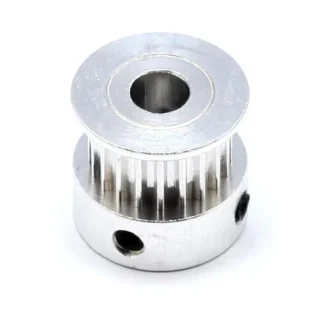
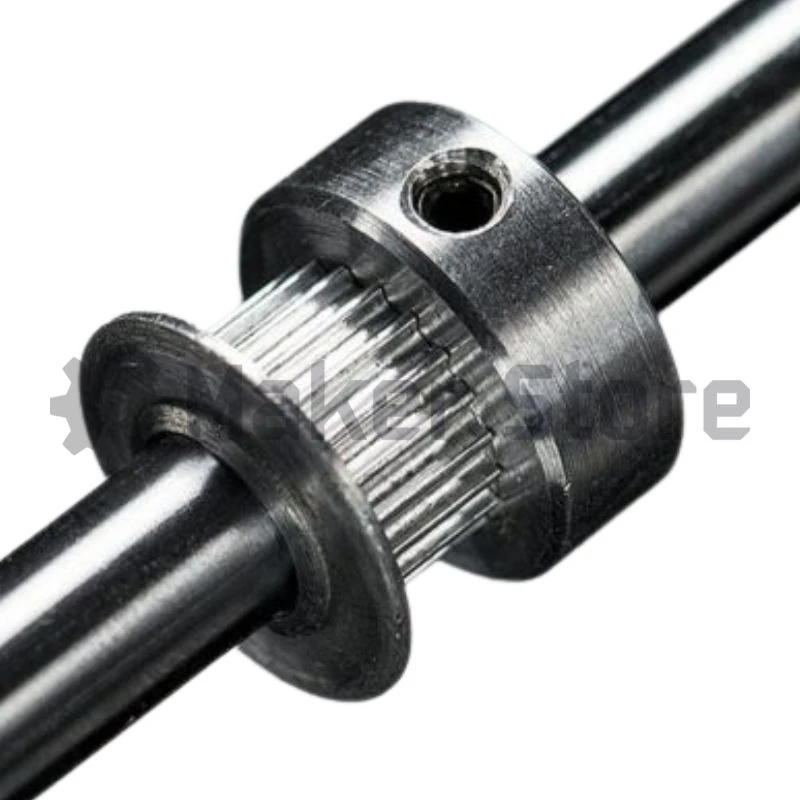
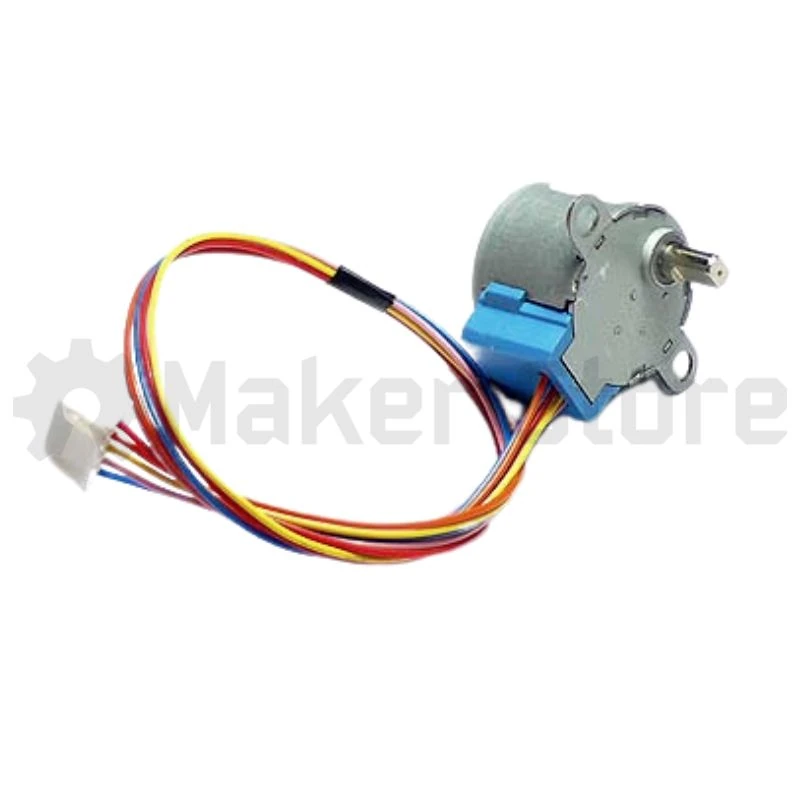
This stepper motor and driver are used in the Maker Store DIY Arduino Controller Camera Slider Project. The 5mm shaft fits the GT2 pulleys.
Product Details:
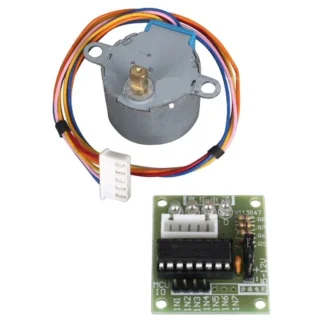
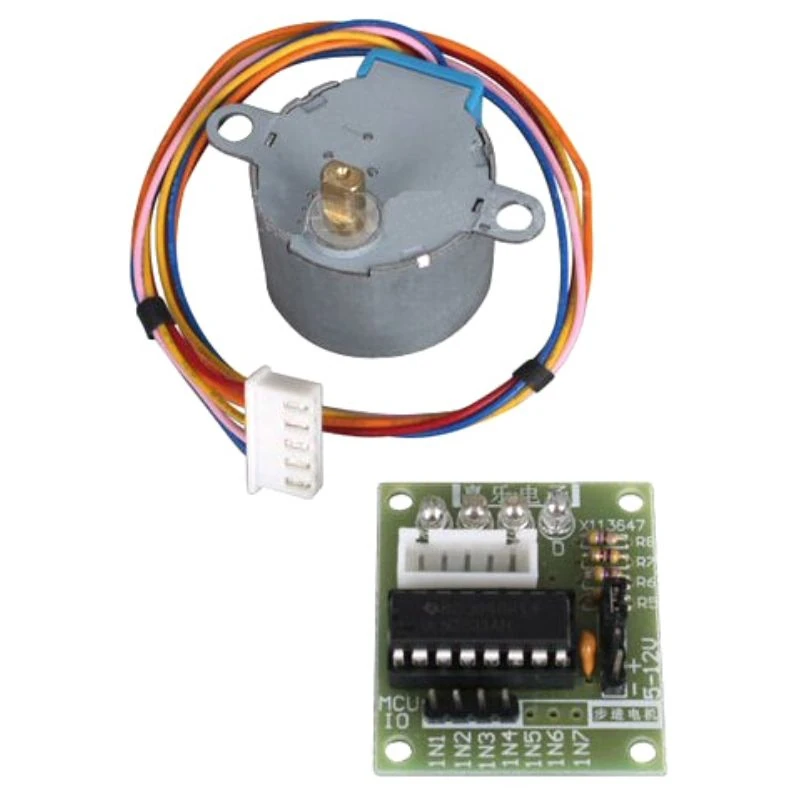
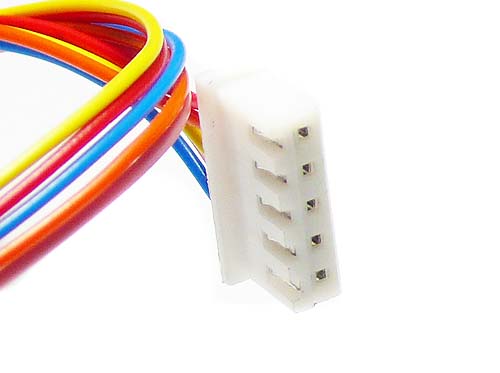
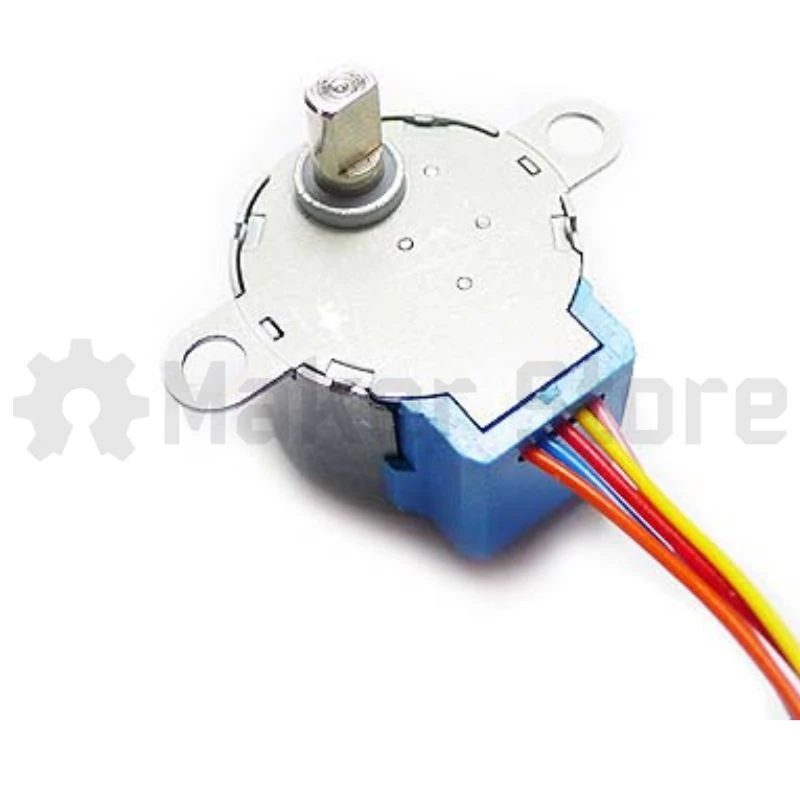
Stepper motor, 28BYJ48, with a 5-way connector
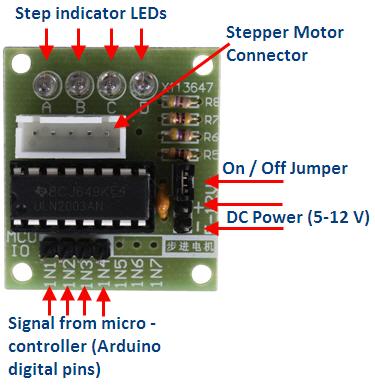
Driver board, containing 4 Darlington drivers (ULN2003) and 4 LEDs
Stepper Motor Features:
- Model No: 28BYJ-48
- Unipolar Stepper with 0.1″ Spaced 5-pin Cable Connector
- 4096 Steps Per Revolution (5.625 degree step angle – 64 steps per rev + 64:1 gear ratio)
- 1/64 Geared Down Reduction
- 5V DC Suggested Operation
- Weight: 37 g.
- Dimensions: 28mm diameter, 20mm tall not including 9mm shaft with 5mm diameter
- 9″ / 23 cm long cable
- Holding Torque: 150 gram-force*cm, 15 N*mm (2 oz-force*in)
- Shaft: 5mm diameter flattened
Combined with our GT2 20 tooth pulley one revolution produces 40 mm of linear motion or 1/102.4mm per step (thanks Richard!)
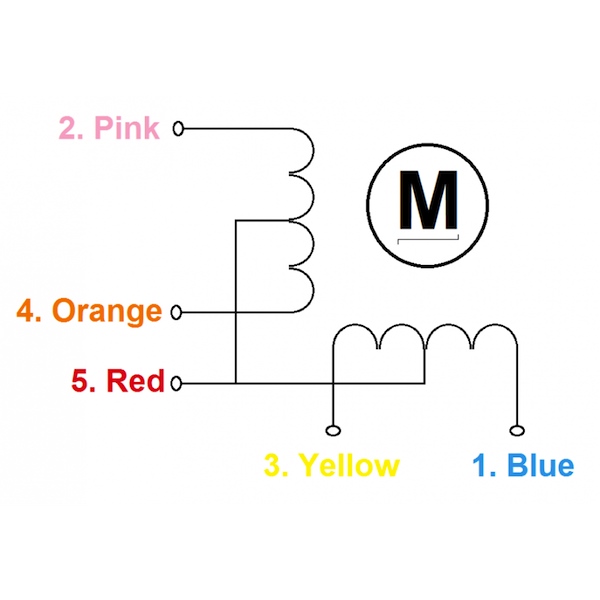
Motor Connections:
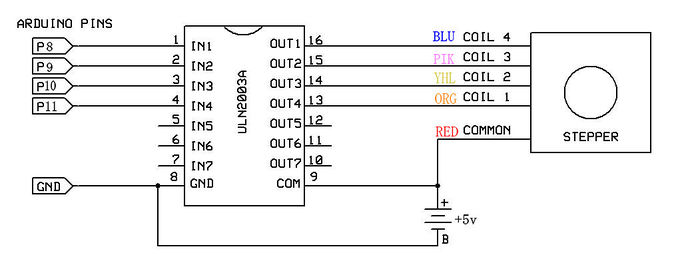
Driving the Motor:
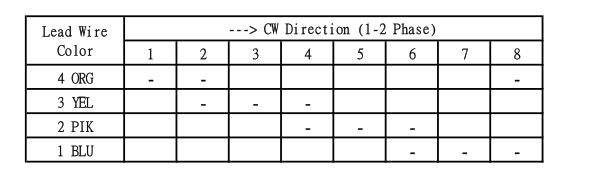
You should drive the motor by enabling the pins in an 8-phase order as shown to the left (Clockwise movement):
- Drive IN4 only
- Drive IN4 and IN3
- Drive IN3 only
- Drive IN3 and IN2
- etc.
For anti-clockwise motion, simply follow the sequence in reverse
ULN2003 Driver Board:
Example Arduino Code:
// This Arduino example demonstrates bidirectional operation of a
// 28BYJ-48, using a ULN2003 interface board to drive the stepper.
// The 28BYJ-48 motor is a 4-phase, 8-beat motor, geared down by
// a factor of 68. One bipolar winding is on motor pins 1 & 3 and
// the other on motor pins 2 & 4. The step angle is 5.625/64 and the
// operating Frequency is 100pps. Current draw is 92mA.
////////////////////////////////////////////////

//declare variables for the motor pins
int motorPin1 = 8;    // Blue   - 28BYJ48 pin 1
int motorPin2 = 9;    // Pink   - 28BYJ48 pin 2
int motorPin3 = 10;    // Yellow - 28BYJ48 pin 3
int motorPin4 = 11;    // Orange - 28BYJ48 pin 4
                        // Red    - 28BYJ48 pin 5 (VCC)

int motorSpeed = 1200;  //variable to set stepper speed
int count = 0;          // count of steps made
int countsperrev = 512; // number of steps per full revolution
int lookup[8] = {B01000, B01100, B00100, B00110, B00010, B00011, B00001, B01001};

//////////////////////////////////////////////////////////////////////////////
void setup() {
  //declare the motor pins as outputs
  pinMode(motorPin1, OUTPUT);
  pinMode(motorPin2, OUTPUT);
  pinMode(motorPin3, OUTPUT);
  pinMode(motorPin4, OUTPUT);
  Serial.begin(9600);
}

//////////////////////////////////////////////////////////////////////////////
void loop(){
  if(count < countsperrev )
    clockwise();
  else if (count == countsperrev * 2)
    count = 0;
  else
    anticlockwise();
  count++;
}

//////////////////////////////////////////////////////////////////////////////
//set pins to ULN2003 high in sequence from 1 to 4
//delay "motorSpeed" between each pin setting (to determine speed)
void anticlockwise()
{
  for(int i = 0; i < 8; i++)
  {
    setOutput(i);
    delayMicroseconds(motorSpeed);
  }
}

void clockwise()
{
  for(int i = 7; i >= 0; i--)
  {
    setOutput(i);
    delayMicroseconds(motorSpeed);
  }
}

void setOutput(int out)
{
  digitalWrite(motorPin1, bitRead(lookup[out], 0));
  digitalWrite(motorPin2, bitRead(lookup[out], 1));
  digitalWrite(motorPin3, bitRead(lookup[out], 2));
  digitalWrite(motorPin4, bitRead(lookup[out], 3));
}
Sources:
- http://www.4tronix.co.uk/arduino/Stepper-Motors.php
- http://www.geeetech.com/wiki/index.php/Stepper_Motor_5V_4-Phase_5-Wire_%26_ULN2003_Driver_Board_for_Arduino